> For the complete documentation index, see [llms.txt](https://docs.openkey.cloud/llms.txt). Markdown versions of documentation pages are available by appending `.md` to page URLs; this page is available as [Markdown](https://docs.openkey.cloud/api/model-voice.md).
# 语音模型 调用示例
**本文中,我们将介绍如何使用 Python 调用** [**OpenKEY**](https://openkey.cloud/) **提供的ChatGPT API接口来调用 ChatGPT 语音模型,即 Whisper 和 TTS。**
**系统环境:**
> Python 3.8.10
>
> Name: openai Version: 0.27.8
#### 1. Whisper 模型
Whisper 模型主要功能为转录和翻译,它们可以用于:
* 将音频转录为任何语言。
* 将音频翻译并转录成英语。
目前文件上传限制为 25 MB,并支持以下输入文件类型:mp3、mp4、mpeg、mpga、m4a、wav 和 webm。
{% hint style="info" %}
注意:接口返回格式仅支持json格式,其他尚未适配调用会报错。
{% endhint %}
**1.1 音频转文本**
```python
# 音频转文本
import requests
headers = {
'Authorization': f'Bearer sk-xxxx', # 注:key为OpenKey创建的令牌
}
url = "https://openkey.cloud/v1/audio/transcriptions" # 注意这里是/transcriptions
file_path = r"./src/voice_250.mp3" # 文件地址
files = {'file':open(file_path, "rb")}
query = {
"model":"whisper-1",
"language":"zh", # 简体汉语
"response_format":"json", # 注意:OpenKey接口目前仅支持json一种格式,否则会报错
}
response = requests.post(url=url, data=query,files=files, headers=headers)
print(response.text)
```
终端输出如下:
 **1.2 音频转英文**
```
# 音频转英文
import requests
headers = {
'Authorization': f'Bearer sk-xxxx', # 注:key为OpenKey创建的令牌
}
url = "https://openkey.cloud/v1/audio/translations" # 注意这里是/translations
file_path = r"./src/voice_250.mp3" # 文件地址
files = {'file':open(file_path, "rb")}
query = {
"model":"whisper-1",
"response_format":"json", # 注意:OpenKey接口目前仅支持json一种格式,否则会报错
"prompt":"This is English"
}
response = requests.post(url=url, data=query,files=files, headers=headers)
print(response.text)
```
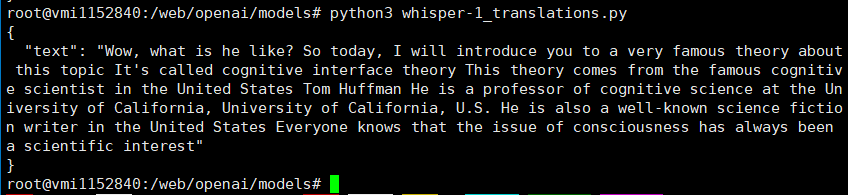
终端输出如下:
**1.2 音频转英文**
```
# 音频转英文
import requests
headers = {
'Authorization': f'Bearer sk-xxxx', # 注:key为OpenKey创建的令牌
}
url = "https://openkey.cloud/v1/audio/translations" # 注意这里是/translations
file_path = r"./src/voice_250.mp3" # 文件地址
files = {'file':open(file_path, "rb")}
query = {
"model":"whisper-1",
"response_format":"json", # 注意:OpenKey接口目前仅支持json一种格式,否则会报错
"prompt":"This is English"
}
response = requests.post(url=url, data=query,files=files, headers=headers)
print(response.text)
```
终端输出如下:
 #### 2. TTS 模型
TTS 模型主要的功能是将文字转语音,具体模型有以下两个:
* **tts-1**: 这是最新的TTS模型,主要针对实时文本转语音使用案例进行了性能优化,速度更快。
* **tts-1-hd**: 与tts-1类似,但更注重语音质量,适用于对语音质量要求更高的场景。
```python
import requests
import json
headers = {
'Authorization': f'Bearer sk-xxxx', # 注:key为OpenKey创建的令牌
'Content-Type':'application/json'
}
url = "https://openkey.cloud/v1/audio/speech"
input_text = "《三国演义》以东汉末年三国时期为背景,展现了刘备、关羽、张飞等英雄豪杰的壮丽故事。他们桃园结义,共同抵抗董卓、曹操等反动势力,最终形成了三足鼎立的局面。小说描写了忠义仁爱、智勇双全的形象,同时也展现了权谋斗争和人性的复杂性。《三国演义》是一部具有高历史价值和文学艺术价值的作品,塑造了许多永垂史册的英雄形象,对中国传统文化产生了深远影响。"
query = {
"model":"tts-1-hd",
"input":input_text,
"voice":"alloy",
"response_format":"mp3",
"speed":1,
}
response = requests.post(url=url, data=json.dumps(query), headers=headers)
# 保存文件
f = open("./src/tts-1-hd.mp3", "wb")
f.write(response.content)
f.close()
```
**实现效果如下:**
{% embed url="" %}
OpenKey完全兼容OpenAI接口协议,具体调用方法参考官方文档:
#### 2. TTS 模型
TTS 模型主要的功能是将文字转语音,具体模型有以下两个:
* **tts-1**: 这是最新的TTS模型,主要针对实时文本转语音使用案例进行了性能优化,速度更快。
* **tts-1-hd**: 与tts-1类似,但更注重语音质量,适用于对语音质量要求更高的场景。
```python
import requests
import json
headers = {
'Authorization': f'Bearer sk-xxxx', # 注:key为OpenKey创建的令牌
'Content-Type':'application/json'
}
url = "https://openkey.cloud/v1/audio/speech"
input_text = "《三国演义》以东汉末年三国时期为背景,展现了刘备、关羽、张飞等英雄豪杰的壮丽故事。他们桃园结义,共同抵抗董卓、曹操等反动势力,最终形成了三足鼎立的局面。小说描写了忠义仁爱、智勇双全的形象,同时也展现了权谋斗争和人性的复杂性。《三国演义》是一部具有高历史价值和文学艺术价值的作品,塑造了许多永垂史册的英雄形象,对中国传统文化产生了深远影响。"
query = {
"model":"tts-1-hd",
"input":input_text,
"voice":"alloy",
"response_format":"mp3",
"speed":1,
}
response = requests.post(url=url, data=json.dumps(query), headers=headers)
# 保存文件
f = open("./src/tts-1-hd.mp3", "wb")
f.write(response.content)
f.close()
```
**实现效果如下:**
{% embed url="" %}
OpenKey完全兼容OpenAI接口协议,具体调用方法参考官方文档: